SOURCE: Jerome Butler, July 8, 2002
1 2021-02-05T16:52:48-06:00 Dan Harper eff3db32ed95b3efe91d381826e2c10c145cd452 26 1 plain 2021-02-05T16:52:48-06:00 Dan Harper eff3db32ed95b3efe91d381826e2c10c145cd452This page is referenced by:
-
1
2021-02-01T14:00:09-06:00
City Beautiful, City Cultural
22
plain
2021-02-10T14:40:07-06:00
img: [Children with thank-you signs at dedication of Welles Park field house and pool, 1970. RJD_04_01_0032_0010_002]
img: [Commemorative paperweight--Lawndale Times Annual Award, 1957. RJD_06_01_0002_0013_001]
img: [Ribbon. Mayor's Citizens Committee for a Cleaner Chicago, Annual Cleaner Chicago Parade, Honorary Parade Marshal, undated. RJD_01_04_0007_0007_001]
img: [Dr. Paul Dudley White and Richard J. Daley riding a tandem bike to help open a bicycle path on Ogden Avenue in Chicago, 1956. RJD_04_01_0004_0004_013]The mayor was very much involved, as is his son, in beautifying the city. So he created urban beautification awards. Every year, they would give plaques to different people who had won awards.
Jerome Butler, City Architect, interview excerpt, July 8,2002
img: [11th Ward Cleanup Float, undated. RJD_04_01_0038_0020_006]We used to hand sweep the streets at night with a small crew in the downtown streets only. But it was a pretty wide area. Well, all of the visitors would come to Chicago. And these guys with the hand brooms would get between the cars. They’d get all the debris. If you went to New York, you’d see it all over. Well, people would come and they’d see all of this wonderful, cleaned up, downtown area. And they attributed it to being the same throughout it.
James McDonough, Commissioner of Department of Streets and Sanitation, interview excerpt, September 17, 2003
img: [Letter to Mayor Daley about the 11th Ward Spring Cleanup Program, 1971. RJD_01_01_0102_0005_023]
img: [Jack Brickhouse of WGN interviewing Mayor Richard J. Daley about a Cleanup Parade on State Street, April 12, 1958. RJD_04_01_0019_0012_006]
img: [State Street in the Loop, ca. 1965: possibly CPC_04_D_1194_008???]
img: [Richard J. Daley unveiling McFetridge Dr. sign surrounded by watching crowd, July 14, 1970. McFetridge drive was a causeway into Chicago's "Museum Campus" where the Shedd Aquarium, Field Museum, and Adler Planetarium are located. RJD_04_01_0032_0009_005]Well, one man that had a big business on Michigan Avenue came to him and suggested that he’d like to donate money to the city for the beautification and did. So Dick turned to him and he said, “No, the city has the money. I’ll tell you what you can do. We have the flower boxes. The city will donate those to the merchants for the streets. During the four seasons of the year, you businessmen can donate the flowers. That’d be a project for you people.” And they were greatly impressed with that. He didn’t just want the money to do it. He wanted to let them do it. They felt that they were part of the operation….But he always wanted the best.
Eleanor Daley, wife of Richard J. Daley, interview excerpt, January 17, 2003
img: [Neighborhood Farm Program, page from packet explaining the program, 1975. RJD_01_01_0146_0007_002]
img: [Scene from the dedication of the Picasso sculpture, August 1967. RJD_04_01_0026_0007_006]
While Daley was mayor, the city commissioned famed artist Marc Chagall to create a public mosaic downtown. Translation of Chagall’s letter:
img: [Under Daley's watch, the city commissioned famed artist Marc Chagall to create a public mosaic downtown. Marc Chagall to Richard J. Daley, October 12, 1974. RJD_01_02_0001_0005_002]I have just received your letter of October 4. I thank you; and I must also express my emotion and gratitude for the warm greeting that you and your city gave me. I want to assure you that it is one of the best memories of my life. My wife joins me in sending to you and Mrs. Daley our most cordial sentiments.
Marc Chagall, Artist, letter to Mayor Richard J. Daley, October 12, 1974 -
1
2021-02-01T13:46:38-06:00
Working for the Mayor
19
plain
2021-02-08T12:18:52-06:00
You had a direct relationship. There was no in-between. Several of the subsequent mayors have had layers of administration. With Daley, it was direct, one on one.
Jerome Butler, City Architect, interview excerpt, July 8, 2002
img: [City Treasurer Joseph Bertrand, Mayor Richard J. Daley, and City Clerk John Marcin after election victory. Photo: László Kondor. MSLASZ13_0001_0013_001]
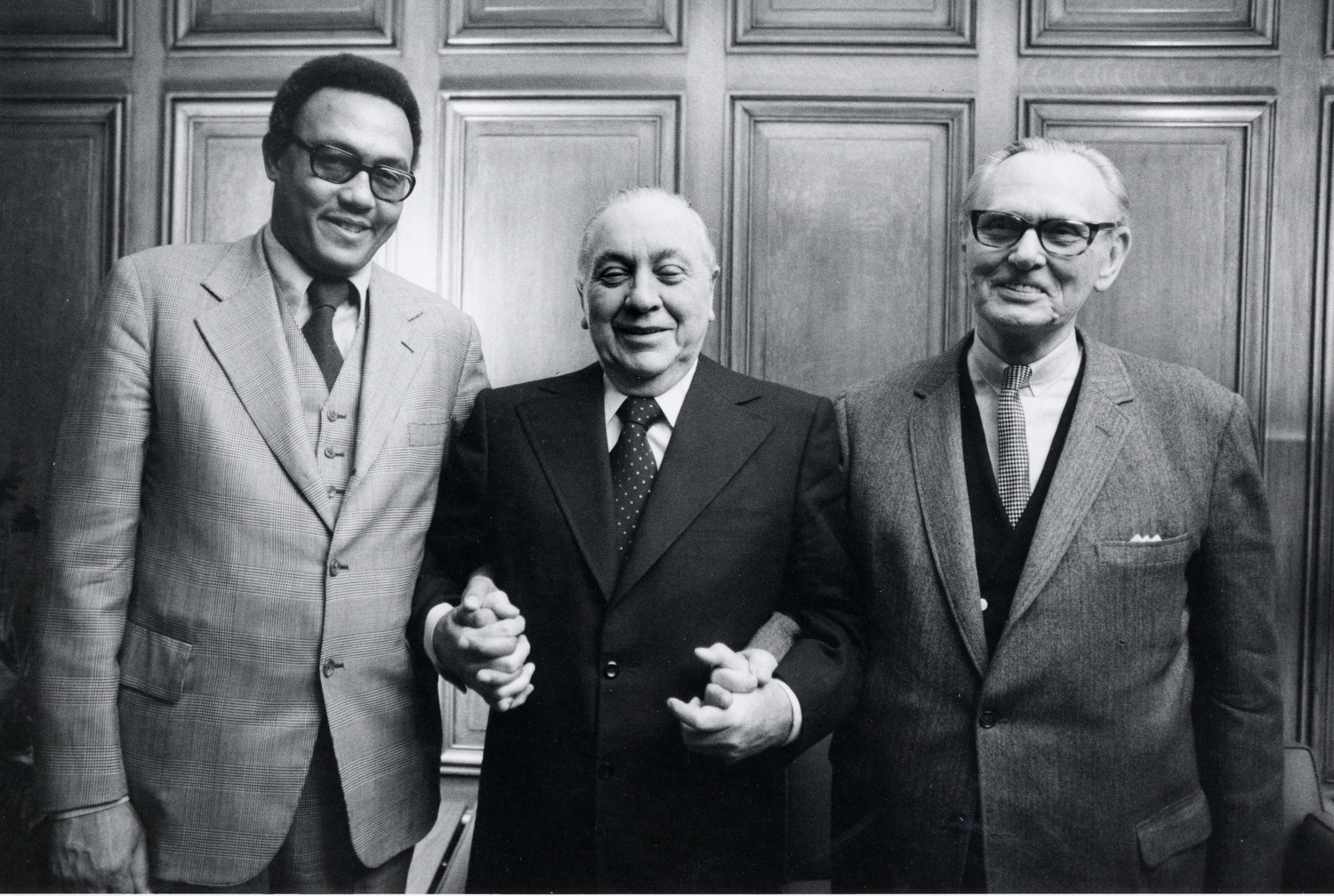
img: [Richard J. Daley, Alderman Michael Bilandic, and Architect for the City of Chicago, Jerome Butler. Photo: László Kondor. MSLASZ13_0003_0002_007]I just think that Daley went in and, to many people’s surprise, he appointed young, professorial type people to key positions. And he relied on them….They weren’t all, ‘Yes men.’ They were people who were unique in their fields and in their professions.
Richard Elrod, Chief Prosecutor for City of Chicago, interview excerpt, April 10, 2009That’s not a field you’re going into to get rich. He was able to convince some people, who obviously became financially more successful in many cases, to make some sacrifices and work for this cause….There was this unique, charismatic leadership about him that just drew people to him and made them want to win with him.
Peter Thompson, grandson of Richard J. Daley, June 11, 2002He always called me Joe when he was happy with me. He normally called me Commissioner, and if he was really mad at me he’d call me Mr. Fitzgerald.
Joseph Fitzgerald, Chicago Building Commissioner, interview excerpt, July 24, 2014
img: [Richard J. Daley in elevator on way to work. RJD_04_01_0022_0004_003]So he’d keep pounding away at whatever the problems were and trying to bring in new ideas. He was susceptible to new ideas, if they were good ideas, no matter who gave them to him, even if it was the guy who was the starter to the elevators down on the main floor of the hall, or one of his cabinet people, or if it was a social acquaintance of his. He really was open. He also had a kind of common touch.
Ray Simon, Corporation Counsel City of Chicago 1965-1969, interview excerpt, June 30, 2010Daley wanted to make every decision, from who put the light on and who flushed the toilet. He wanted to make every decision. But the nice thing about Daley was that he had a cadre of people around him and he would take advice.
Dan Rostenkowski, Congressman, interview excerpt, July 1, 2004
img: [Mayor Richard J. Daley speaking, undated. RJD_04_01_0041_0002_024]Critics mock the mispronunciation or tangled syntax of the mayor’s public speaking, but none of that criticism is from anyone who ever participated in a one-on-one or a small group meeting with him. Up close and personal he was a powerhouse.
Richard L. Curry, Corporation Counsel City of Chicago 1970-1974, excerpt from written statement, November 10, 2014
img: [Richard J. Daley at secretaries’ luncheon with “The Dependables,” 1963. Photo: Mart Studios. RJD_04_01_0022_0013_003]Mary Junquera was his secretary for many years. She said that every single night when he left the office, he came to her desk and thanked her for her work that day. He said, “With the help of God, I’ll see you tomorrow.”
Patricia Daley-Martino, daughter of Richard J. Daley, interview excerpt, June 12, 2002
img: [Official portrait of Mayor Richard J. Daley. Photo: László Kondor. MSLASZ13_0002_0010_034]
Mayor Daley's official photographer remembers how he took what came to be the iconic, official photograph of the mayor:
-
1
2021-02-01T13:59:49-06:00
Making the City Work
16
plain
2021-02-09T12:35:35-06:00
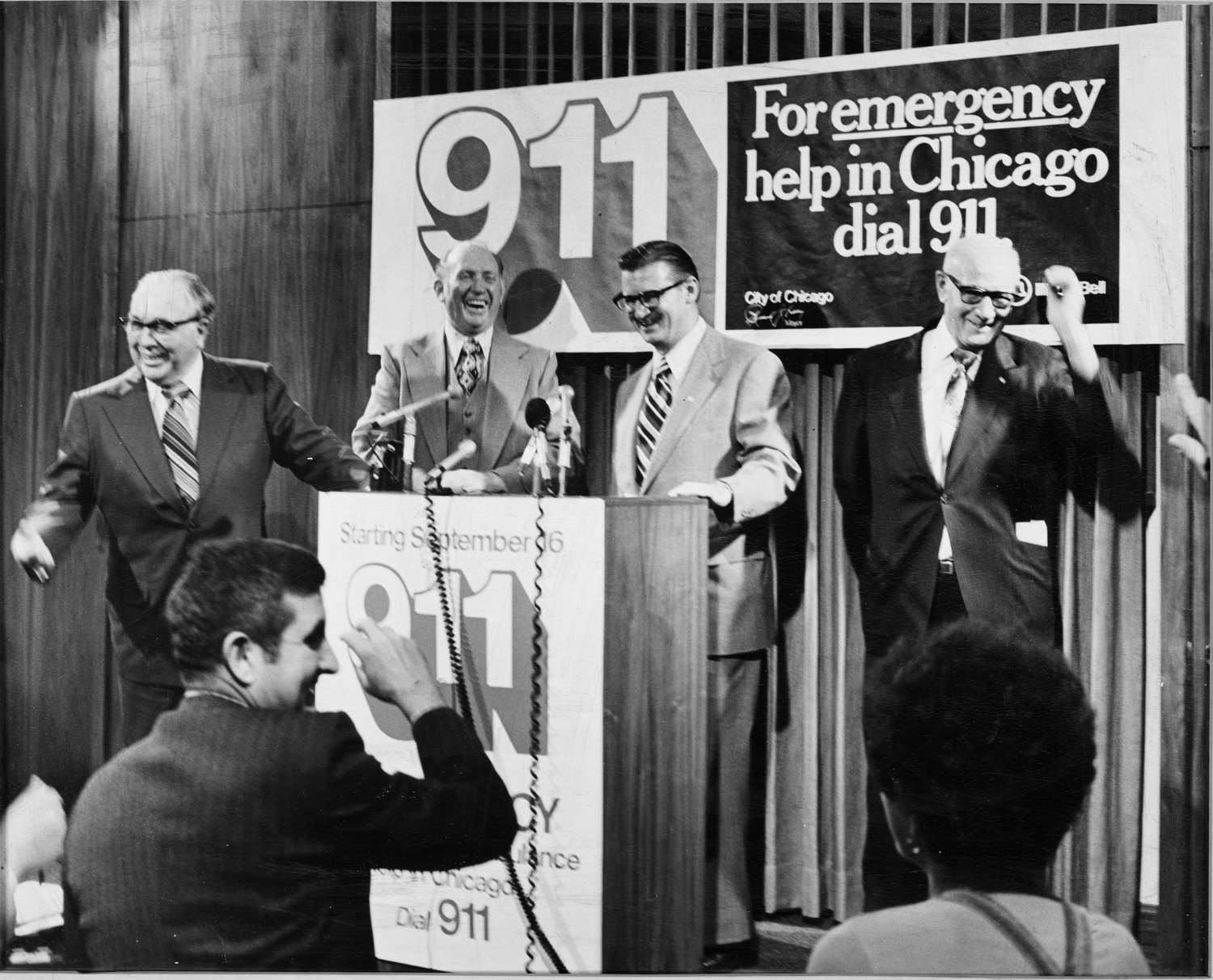
img: [Richard J. Daley onstage at what is probably a 911 kickoff event. Chicago adopted 911 for all emergency calls in 1976. RJD_04_01_0067_0002_005]One of his top priorities as mayor was to improve the delivery of city services to all of the neighborhoods and to all of the people of Chicago. When you look at the city’s Capital Improvement Program during his administration and the emphasis that was placed on constructing new facilities for every city department, you get a clear picture of the mayor’s priorities. As the City Architect, I had the opportunity and responsibility for the design and construction of these new facilities. New Police, Fire, Health, Senior, Community Service, Library, Streets and Sanitation, and Transit facilities were completed in neighborhoods throughout the city. All designed to improve the delivery of city services.
Jerome Butler, City Architect, interview excerpt, July 8,2002
img: [Mayor Richard J. Daley to William L McFetridge of the Chicago Park District, 1967. RJD_01_01_0058_0004_020]I think that you can see how development helps a community. That’s not only from providing amenities in that area that will serve the people long after it’s built, but also the jobs it creates to build that amenity.
Patrick Thompson, grandson of Richard J. Daley, interview excerpt, June 13, 2002
Daley expanded and professionalized police and fire services.Those filtration plants are the lifeblood, not of the city, but of this region. Well, that wasn’t popular. It wasn’t popular at all. Build something in the lake? How could you do that? How could you even conceive that? But he knew that was right. He knew that we had to have clean water, if we were going to have cities in the surrounding areas. The foresight that he had was always, “What’s good for the city? And what’s good for its people?” Politically, at times, it was difficult.
Ed Bedore, City Budget Director, interview excerpt, May 18, 2009
img: [This photo from 1967 shows the snow accumulating at the Wavers Apartment Buildings, at Lamont and Archer. RJD_04_01_0026_0005_001]We re-did the headquarters. We built a communications center. We worked with O. W. Wilson in the reorganization of the Police Department and built a series of area headquarters, which were never built before, after Wilson came in. We started with the Area 4 Police Headquarters, then Area 6, and then the Police Training Academy. The city never had a police training academy until Wilson came in. Here’s the fire department. They never had a fire academy until Daley came in. They built a new fire academy.
Jerome Butler, City Architect, interview excerpt, July 8,2002
In 1967, 23 inches of snow fell within 35 hours — the largest single snowfall in the city’s history. Businesses closed, roofs collapsed, cars were abandoned, and many Chicagoans were stranded.
img: [Citation to Richard J. Daley for efforts during 1967 snowstorm from Back of the Yards Neighborhood Council, 1967. RJD_06_01_0014_0002_001]
The city had a number of programs for youth.We didn’t have the power. We didn’t have the strength. We didn’t have a good plan. We didn’t have anything. And Mayor Daley pulled it off because of his charisma on television, telling everyone how good we were doing. We really weren’t doing so good.
James McDonough, Commissioner of Department of Streets and Sanitation, interview excerpt, September 17, 2003
img: [Richard J. Daley pours milk with Scouts on lakefront, 1962. RJD_04_01_0020_0019_011]
img: [Youth Foundation award winners at Presidential fitness award event, 1966. RJD_04_01_0025_0009_016]
Services for the neighborhoods and the wards.
img: [Commissioner of Parks Ed Kelly with Mayor Richard J. Daley at Neighborhood Program event, ca. 1972-1976. Photo: László Kondor. MSLasz13_0003_0003_002]I was Alderman of the Ninth Ward from 1971 to 1979—8 years. The Ninth Ward, under the leadership of Mayor Richard J. Daley, received many important improvements including: a new library in West Pullman, a new grammar school in West Pullman, a new high school in Altgeld-Murray Homes, addition to Curtis Junior High School at 115th Street and State Street, building Chicago Police Department Area 2 Headquarters at 111th and the Calumet Expressway with a City of Chicago Court, City of Chicago Landmark status for Pullman in 1972, and a new roof for Hotel Florence in 1975.
Alexander A. Adduci, Alderman, interview excerpt, July 18, 2014
img: [Civil Defense. Mayor Daley inspects canon drills near Michigan Avenue, 1960. RJD_04_01_0018_0004_002]