SOURCE: Richard L. Curry, November 10, 2014
1 2021-02-02T11:27:14-06:00 Dan Harper eff3db32ed95b3efe91d381826e2c10c145cd452 26 11 plain 2021-02-02T16:40:59-06:00 Dan Harper eff3db32ed95b3efe91d381826e2c10c145cd452This page is referenced by:
-
1
media/MSLASZ13_0002_0010_003_hero.jpg
2021-01-25T17:17:32-06:00
Remembering Richard J. Daley
56
image_header
2021-02-04T13:00:29-06:00
img: [hero-image-rjd; Richard J. Daley main image; MSLASZ13_0002_0010_003_crop.jpg; MSLASZ13_0002_0010_003]
In April 1955 he took a sleepy, “nothing is happening” city and refused to let the rust-belt predictions of the times threaten for even another day. He generated a “can-do” mindset, enlisted corporate and labor leaders and made “no little plans.
Richard L. Curry, Corporation Counsel City of Chicago 1970-1974 -
1
2021-02-01T14:53:14-06:00
Remembering the Mayor
19
plain
2021-02-16T09:36:42-06:00
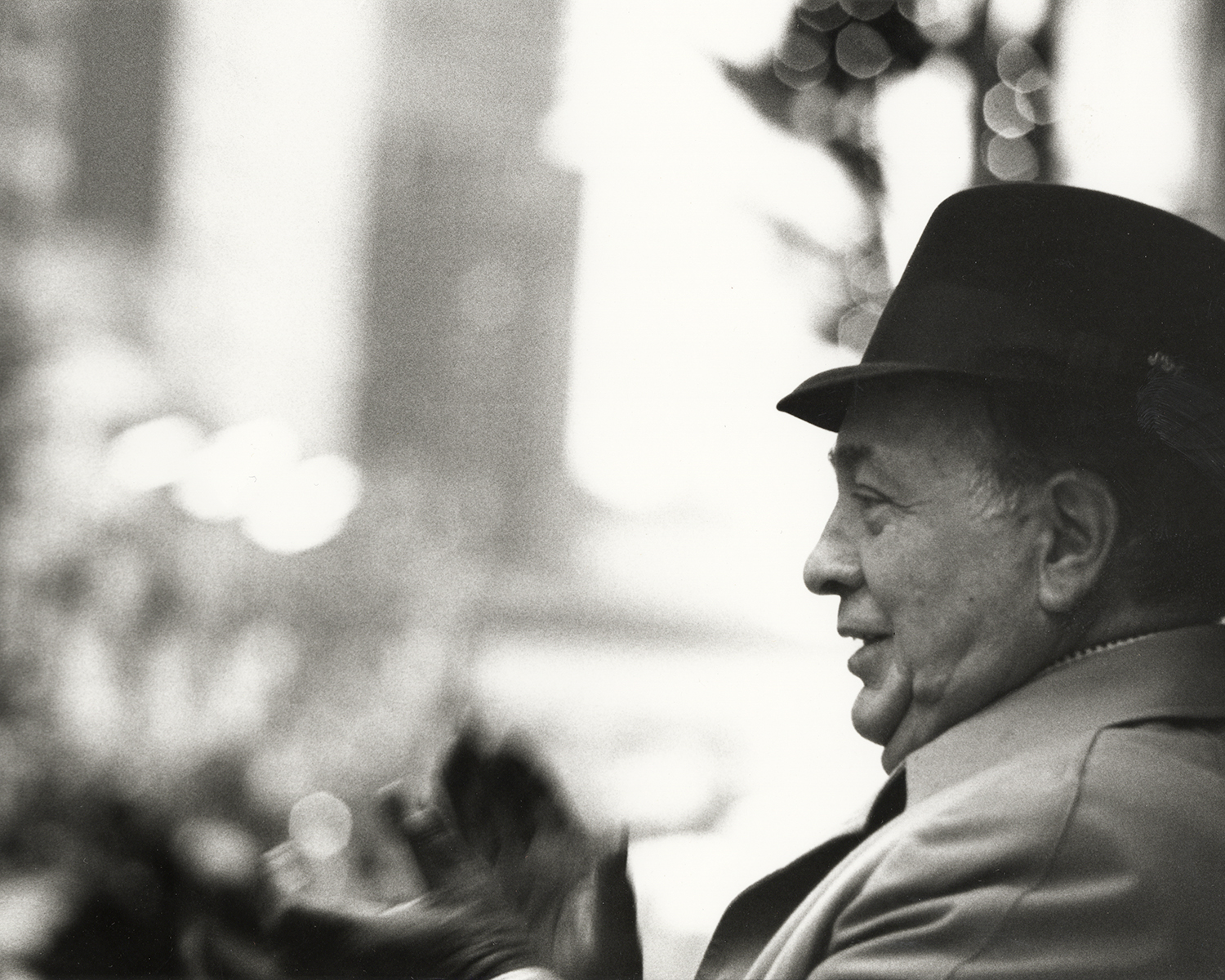
img: [Richard J. Daley waving at St. Patrick’s Day parade. Photo: László Kondor. MSLASZ13_0004_0011_019]
He was the right person for the job at the right time. There was a tremendous demand for housing, a demand for consumer products, and a demand for expansion, with office space and everything else. And that’s exactly as I saw Mayor Daley. That’s what he wanted to accomplish. He wanted to build Chicago. He wanted to make it better. He wanted to improve it, both through construction and through education. I think the only thing that trumped his interest in doing that was his devotion to his family. He was about as family oriented a person as I think that I have ever known.
Lester Crown, Financier, interview excerpt, August 31, 2009
img: [Richard J. Daley accepts a neighbor’s congratulations the day after the 1955 mayor election, 1955. RJD_04_01_0012_0002_001]He will always be seen as one of the great mayors, who took a very complex, complicated city in an extremely difficult time and made it a model for the nation and the world.
Andrew Young, Mayor of Atlanta, interview excerpt, October 20, 2014I think he would like to be remembered as a man who ran a tight ship and a good city. He was proud of his Chicago.
Wilson Frost, Alderman, interview excerpt, November 13, 2014
img: [Richard J. Daley on the telephone while seated at a desk, undated. Photo: Illinois Bell Telephone Company. RJD_04_01_0040_0005_006]Daley was liberal. He had some blind sides on some things, particularly on civil rights, and issues like education, and to some extent in housing. The public high-rises were an example. He was a governmental activist. He was calling me and saying, ‘Why aren’t you doing more on transportation?’ So, you say liberal, yes and no. He was the boss. But he was an old time, kind of new deal type of Democrat.
Adlai Stevenson III, Illinois Politician, interview excerpt, July 9, 2003
img: [Mayor Richard J. Daley at a podium. Photo: Laszlo Kondor. MSLASZ13_0002_0010_020]When I think you look back in history as to where this city was in the 40’s and early 50’s and where it came out in 1976, it’s the city that it is now, and it’s set up now to only become a better city. And I think that foundation is what was started with my grandfather, and continued on with other mayors. But I think if those accomplishments hadn’t occurred during that time period you wouldn’t want to see what the alternative would be. So that pretty much sums up what I am most proud of.
Mark G. Vanecko, grandson of Richard J. Daley, interview excerpt, July 9, 2014
img: [Richard J. Daley stands behind an architectural model, undated. RJD_04_01_0015_0012_007]Overall, I’d give him an “A” for being the mayor. My test would be to compare Chicago with other major cities. Look around the country at major urban centers, during the sixties, seventies, and what happened. Clearly, if you look at New York, Detroit, Los Angeles, Washington D.C., and Cleveland, Chicago came through those years much better than anybody else. And I attribute that, for the most part, to the mayor. So I’d give him an “A” on that.
Newton Minow, Chair of Federal Communications Commission, 1961-1963, interview excerpt, October 2, 2003
img: [Richard J. Daley and Eleanor Daley in voting booth, 1963. RJD_04_01_0022_0008_016]The real burst of energy and the real growth of the city happened during Richard J. Daley’s term of office. I think his motivation at all times was because he loved the city. And I think he should be remembered that way. … He brought us out of the doldrums into one of the great cities of the world. I mean, everybody likes to talk about us as a world class city. He made us a world class city.
Bernard Stone, Alderman, interview excerpts, July 1, 2010
img: [Portrait of Richard J. Daley wearing a carnation and doffing his hat, undated. RJD_04_01_0041_0003_021]How would he like to be remembered? The mayor would have no time for this question. He lived in the present, accepted its challenges, and recognized limitations.
Richard L. Curry, Corporation Counsel City of Chicago 1970-1974, interview excerpt, November 10, 2014He was a great leader, a great person, and a kind and generous man. He was someone who cared about the city.
Thomas Hynes, State Senator, interview excerpt, March 10, 2010 -
1
2021-02-01T13:46:38-06:00
Working for the Mayor
19
plain
2021-02-08T12:18:52-06:00
You had a direct relationship. There was no in-between. Several of the subsequent mayors have had layers of administration. With Daley, it was direct, one on one.
Jerome Butler, City Architect, interview excerpt, July 8, 2002
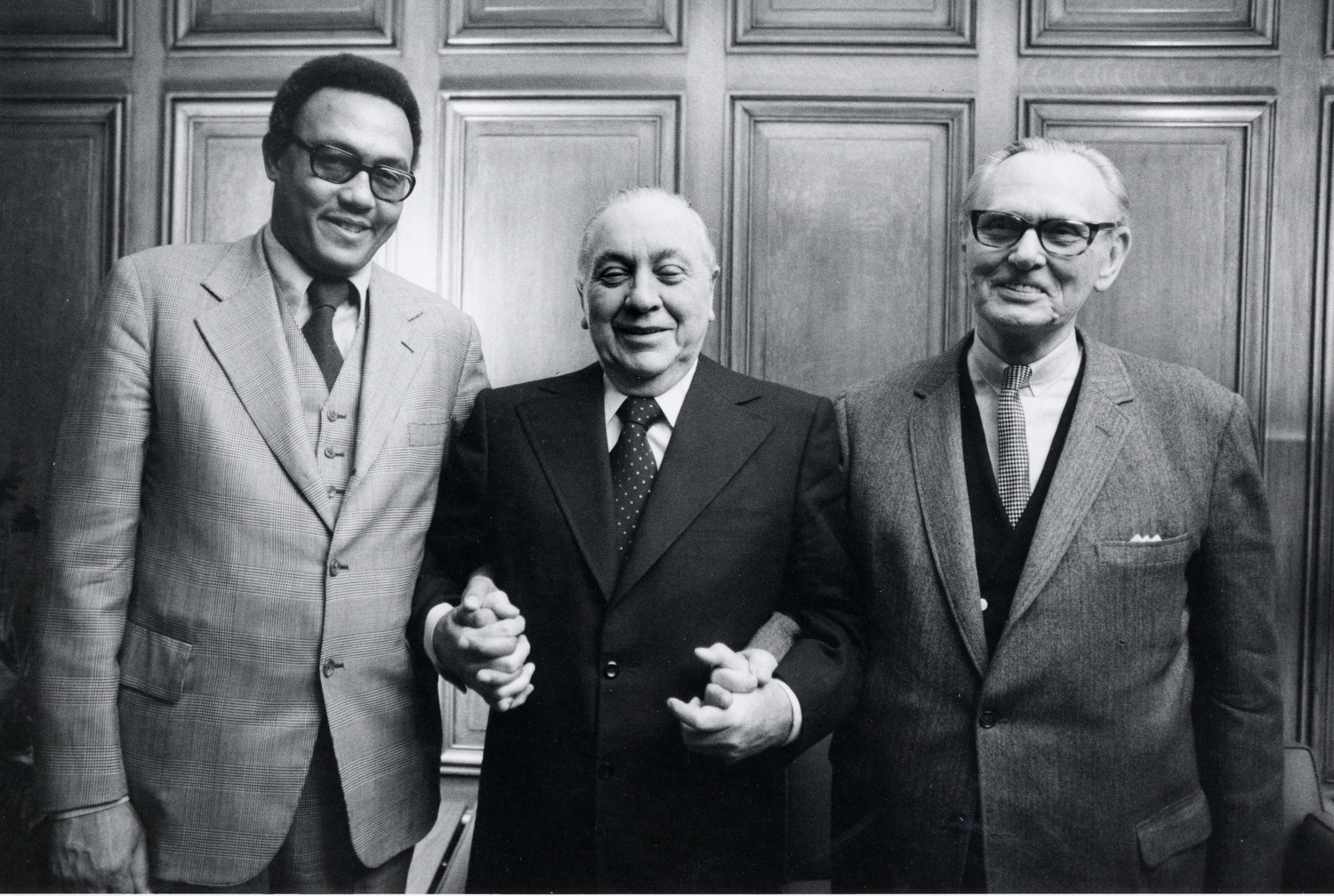
img: [City Treasurer Joseph Bertrand, Mayor Richard J. Daley, and City Clerk John Marcin after election victory. Photo: László Kondor. MSLASZ13_0001_0013_001]
img: [Richard J. Daley, Alderman Michael Bilandic, and Architect for the City of Chicago, Jerome Butler. Photo: László Kondor. MSLASZ13_0003_0002_007]I just think that Daley went in and, to many people’s surprise, he appointed young, professorial type people to key positions. And he relied on them….They weren’t all, ‘Yes men.’ They were people who were unique in their fields and in their professions.
Richard Elrod, Chief Prosecutor for City of Chicago, interview excerpt, April 10, 2009That’s not a field you’re going into to get rich. He was able to convince some people, who obviously became financially more successful in many cases, to make some sacrifices and work for this cause….There was this unique, charismatic leadership about him that just drew people to him and made them want to win with him.
Peter Thompson, grandson of Richard J. Daley, June 11, 2002He always called me Joe when he was happy with me. He normally called me Commissioner, and if he was really mad at me he’d call me Mr. Fitzgerald.
Joseph Fitzgerald, Chicago Building Commissioner, interview excerpt, July 24, 2014
img: [Richard J. Daley in elevator on way to work. RJD_04_01_0022_0004_003]So he’d keep pounding away at whatever the problems were and trying to bring in new ideas. He was susceptible to new ideas, if they were good ideas, no matter who gave them to him, even if it was the guy who was the starter to the elevators down on the main floor of the hall, or one of his cabinet people, or if it was a social acquaintance of his. He really was open. He also had a kind of common touch.
Ray Simon, Corporation Counsel City of Chicago 1965-1969, interview excerpt, June 30, 2010Daley wanted to make every decision, from who put the light on and who flushed the toilet. He wanted to make every decision. But the nice thing about Daley was that he had a cadre of people around him and he would take advice.
Dan Rostenkowski, Congressman, interview excerpt, July 1, 2004
img: [Mayor Richard J. Daley speaking, undated. RJD_04_01_0041_0002_024]Critics mock the mispronunciation or tangled syntax of the mayor’s public speaking, but none of that criticism is from anyone who ever participated in a one-on-one or a small group meeting with him. Up close and personal he was a powerhouse.
Richard L. Curry, Corporation Counsel City of Chicago 1970-1974, excerpt from written statement, November 10, 2014
img: [Richard J. Daley at secretaries’ luncheon with “The Dependables,” 1963. Photo: Mart Studios. RJD_04_01_0022_0013_003]Mary Junquera was his secretary for many years. She said that every single night when he left the office, he came to her desk and thanked her for her work that day. He said, “With the help of God, I’ll see you tomorrow.”
Patricia Daley-Martino, daughter of Richard J. Daley, interview excerpt, June 12, 2002
img: [Official portrait of Mayor Richard J. Daley. Photo: László Kondor. MSLASZ13_0002_0010_034]
Mayor Daley's official photographer remembers how he took what came to be the iconic, official photograph of the mayor: