IMAGE_RJD_02_01_0085_0004_024
1 2021-02-12T16:57:31-06:00 Dan Harper eff3db32ed95b3efe91d381826e2c10c145cd452 26 2 Letter from the District of Columbia Democratic National Convention delegation to the Chairman of the Democratic Party, September 13, 1968. RJD_02_01_0085_0004_024. Richard J. Daley collection, University of Illinois Chicago. plain 2021-02-22T14:08:25-06:00 1968 Kate Flynn 89ab0aeaf9441ebcfe2d9d020d3b00b0ffd82873This page is referenced by:
-
1
2021-02-01T14:24:51-06:00
1968: A Key Year
16
plain
2021-02-23T11:43:36-06:00
img: [These notes taken by Michael Daley, son of Richard J. Daley, document activities during the rioting that followed the assassination of Reverend Martin Luther King, Jr., 1968. RJD_01_01_0064_0002_001]I think 1968 was a key year, if not the most important, in recent history. And people forget how tense things were, how fluid. One of my memories from that week was being at home and seeing jets fly overhead. Military jets. And at the office, there were all these maps of the city laid out. There were maps like this of Vietnam, and now there were maps of Chicago. People forget how close the country was to tearing itself apart. Chicago suffered some of its worst race riots during the 1960s, most notably in April 1968 following the assassination of Martin Luther King Jr.
William Daley, son of Richard J. Daley, interview excerpt, December 5, 2008
img: [Letter from the American Friends Service Committee to Richard J. Daley, April 26, 1968. RJD_01_01_0060_0008_007]
In 1968, Chicago hosted the Democratic National Convention at the International Amphitheatre.
img: [Sketch of the meeting hall in the International Amphitheatre for the 1968 Democratic Convention. RJD_04_01_0027_0004_023]
img: [A sign welcomes delegates to the Democratic National Convention, 1968. Photo: Chicago Park District. RJD_04_01_0027_0004_001]
Thousands demonstrated the week before and the week of the convention to protest the Vietnam War and the Democratic Party’s presumptive nominee, Hubert Humphrey. They and the Chicago police clashed on numerous occasions during this two-week period.
img: [List of arrests and injuries, August 18, 1968. RJD_02_01_0085_0004_008]
img: [Richard J. Daley on the convention floor at the Democratic National Convention, 1968. Photo: Rhoden’s Photo and Press Service. RJD_04_01_0027_0004_003]Well, do you know what? Everybody played their parts. The mayor played his part. The police played their part. The protestors played their part. The media played their part. And it all blew up. The pot finally boiled over. It had been boiling and bubbling. And terrible things had happened around the world in 1968. The whole thing blew up and boiled over in Chicago for those five days. Nobody was killed. In his mind, the city didn’t riot. The outsiders rioted.
William Daley, son of Richard J. Daley, interview excerpt, January 12, 2009
img: [Telegram from United Auto Workers Union Local 333 in support of the right to demonstrate, August 21, 1968. RJD_02_01_0083_0012_012]I believe that some forward planning could have averted the disaster that happened. I don’t know.
Newton Minow, Chair of Federal Communications Commission 1961-1963, interview excerpt, October 2, 2003
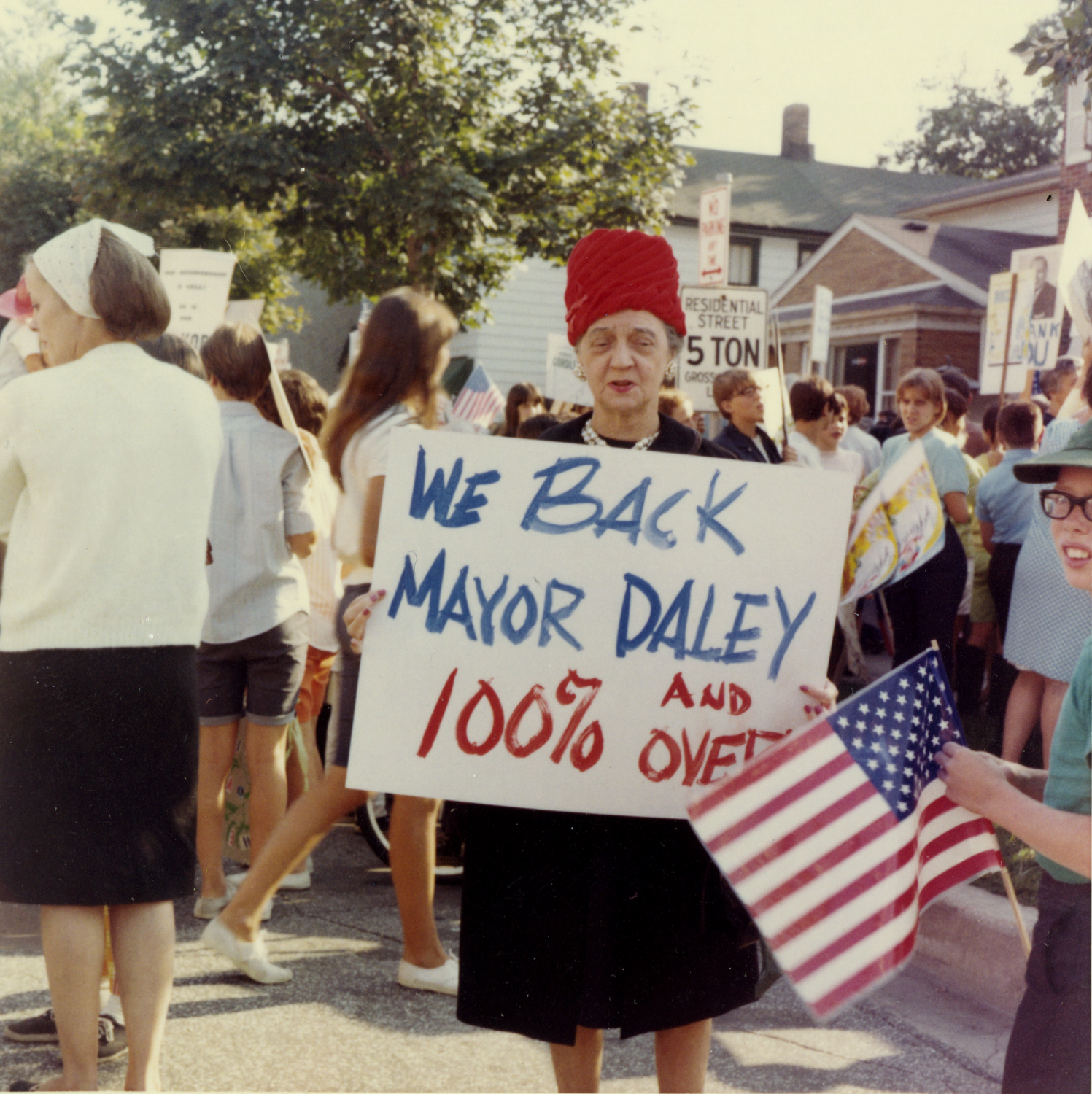
img: [Woman at neighborhood event holding a poster in support of Richard J. Daley, 1968. RJD_04_01_0027_0005_008d]After the convention, the mayor’s office was getting sacks upon sacks of mail. The sacks would probably fill this entire room with mail from around the country saying, “God bless you.”
Ed Bedore, City Budget Director, interview excerpt, May 18, 2009
img: [Letter from the District of Columbia Democratic National Convention delegation to the Chairman of the Democratic Party, September 13, 1968. RJD_02_01_0085_0004_024]The Eastern liberal media that came to Chicago to cover the convention didn’t like Daley. They didn’t like his reputation. But after the convention, Daley could never be defeated. The people of Chicago viewed him as standing up almost like a paterfamilias concept and protecting his city. And he truly did love Chicago, and he wanted nothing more than to be the mayor of Chicago. He could have been Secretary of HEW or whatever if he wanted to, but he never wanted to leave Chicago.
Ed Burke, Alderman, interview excerpt, August 5, 2014